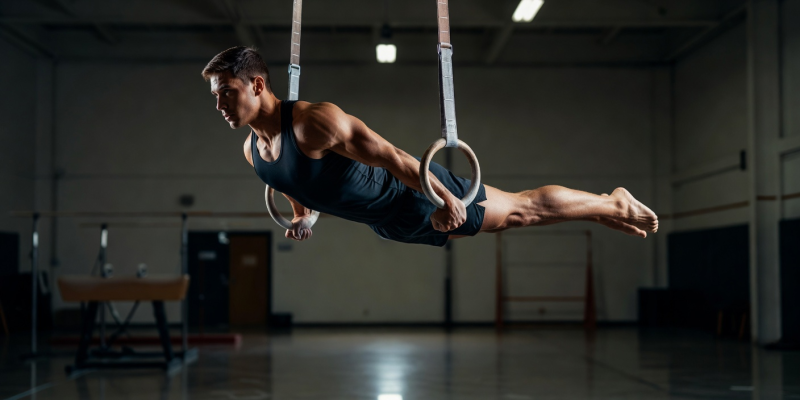
The Physics of Levers
Advanced calisthenics statics are exercises in physics. By moving the body's center of mass further away from the pivot point (your hands or shoulders), the mechanical disadvantage increases exponentially. A front lever requires significantly more back strength than a pull-up simply because your entire bodyweight is held perpendicular to gravity on a long lever arm.
The Planche
The planche is the holy grail of pushing statics. The body is held completely horizontal, face down, supported only by the hands with straight elbows. It demands immense strength in the anterior deltoids, chest, and biceps tendons.
Because the elbows are locked, the biceps act as critical stabilizers. Proper progression is mandatory to avoid bicep tendon tears.
- Progression Path: Planche Lean → Tuck Planche → Advanced Tuck → Straddle Planche → Full Planche.
- Form Standard: Scapula fully protracted (rounded upper back), depressed, and elbows locked out completely. Hips level with shoulders.
The Front Lever
The front lever is the ultimate test of vertical pulling isometric strength. Hanging below the bar, the athlete pulls their body parallel to the ground. It requires enormous latissimus dorsi activation, alongside core and straight-arm strength.
- Progression Path: Tuck Front Lever → Advanced Tuck → One-Leg Extended → Straddle → Full Front Lever.
- Form Standard: Scapula retracted and depressed, straight arms, neutral spine, pointed toes.
The Human Flag
A true crowd-pleaser, the human flag involves holding the body sideways, projecting laterally from a vertical pole. It is an asymmetrical hold that requires massive oblique strength, along with a complex push-pull mechanic in the upper body.
The bottom arm pushes against the pole, recruiting the triceps and shoulders, while the top arm pulls, engaging the lats and biceps. Both sides of the body must be trained equally to prevent muscular imbalances.
The Back Lever
Usually the first advanced static athletes achieve, the back lever is a supine horizontal hold hanging from the bar. While it is easier on the lats and core than the front lever, it places extreme tension on the biceps tendon and the anterior capsule of the shoulder.
A "Skin the Cat" is the prerequisite dynamic movement used to condition the shoulders for the back lever position.
Training Methodology
Training statics requires a shift from repetition-based programming to time-under-tension (TUT). A standard protocol is the PRILEPIN table adapted for isometrics, aiming for a total hold time of 60 seconds per session, broken into manageable sets of 5-15 seconds depending on the difficulty.